
Deep Investment: How to Build Compounding Habit Loops for SaaS [NightCafe Case Study]
I’ve had the pleasure and opportunity of spending the past year in a growth role at NightCafe, a generative AI image generation platform.
In this case study I’ll walk through two product design changes I helped design and implement that meaningfully improved daily engagement and paid retention in a product with over thirty million registered users.
The Results:
- +30% increase in Daily Unique Active Creators (DUAC), sustained eleven months to time of writing.
- ~30% reduction in monthly Churn. Down from ~8.5% to a projected 6.3% from the five months since launch.
Investment = Retention.
NightCafe runs a freemium model. Users get an initial allotment of free credits to generate AI images. Some of those users convert to a paid subscription, where they get more credits and access to premium features like more powerful models.
Like most consumer SaaS, the biggest challenge at NightCafe was new user retention. Not only was getting a user to come back a second day a strong indicator they would eventually convert, but poor new user retention came with a lot of other problems for this particular model and vertical:
Firstly, free credits were a liability. This meant free image generations, which was an open call for future inference costs. If those users don’t contribute to the platform or convert to paid, we bled cash to support them.
Second, it complicated acquisition. SEO traffic that lands, creates an image and bounces is a negative signal for ranking, and this compounds over time. If they subscribe to the email list, even worse. As I wrote in my book on email, list composition is downstream of traffic composition, so your list health, engagement and deliverability eventually deteriorates. Paid also gets harder, because your retargeting quality suffers which leads to increased costs.
Most insidiously, it impacted the roadmap. Without a clear cohort of core habitual users it becomes difficult to tell which features actually matter, or predict what might. Everything gets used a little, nothing gets used a lot. Roadmap prioritisation degrades into either the appeal to authority of “what are our competitors doing”, or qualitative ideas from surveys and interviews that somehow always manage to miss the revealed preference buried in data.
But we got through these mires. Because once a core habit loop is running, the shape of the customer journey, and the paths to value, become so much clearer. It compounds. Every new user becomes more likely to retain, and every new user who retains becomes more likely to convert.
The Hooked Model
It's worth restating the four stages of the Hooked model because this case study is built around it:
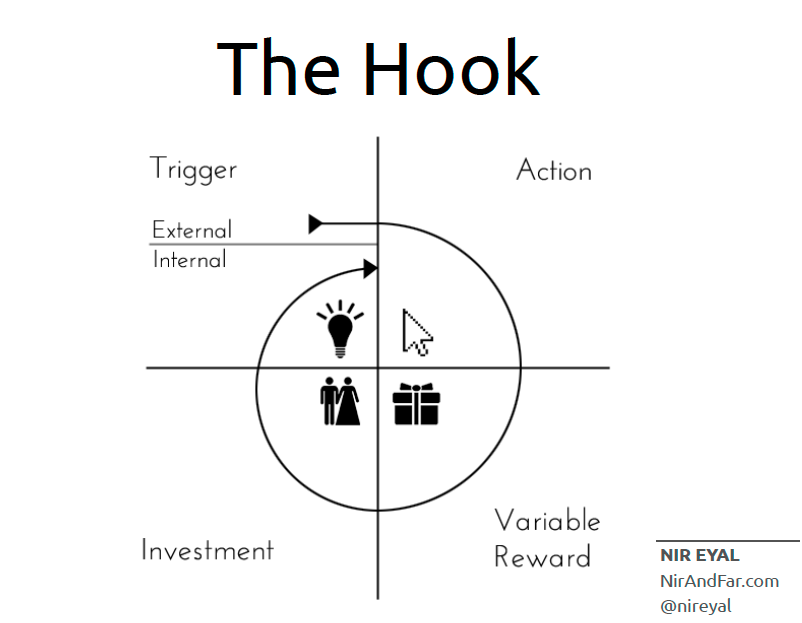
- Trigger — the cue that prompts the behaviour (external at first, internal once a habit forms)
- Action — the behaviour itself, performed in anticipation of a reward
- Variable Reward — the payoff, crucially with an element of surprise or novelty.
- Investment — work the user puts in that increases the value of the product on the next pass through the loop
The two interventions that follow show how I re-imagined our habit loop using Nir Eyal’s Hooked model to produce large increases in our daily unique activated creators (or DUAC, our daily user metric), and then reinforced it to help decrease churn for our paid users.
What I’d like to drive home here is how the investment stage in Nir’s model can be so powerful when used creatively:
In stage one, I show how I redesigned our core habit loop, with an emphasis on the investment stage to improve new user retention.
In stage two, I show how we were then able to deepen that same investment incentive to contribute towards also decreasing churn for our paid users.
Stage One: Reworking the Core Habit Loop (June / July 2025)
Before
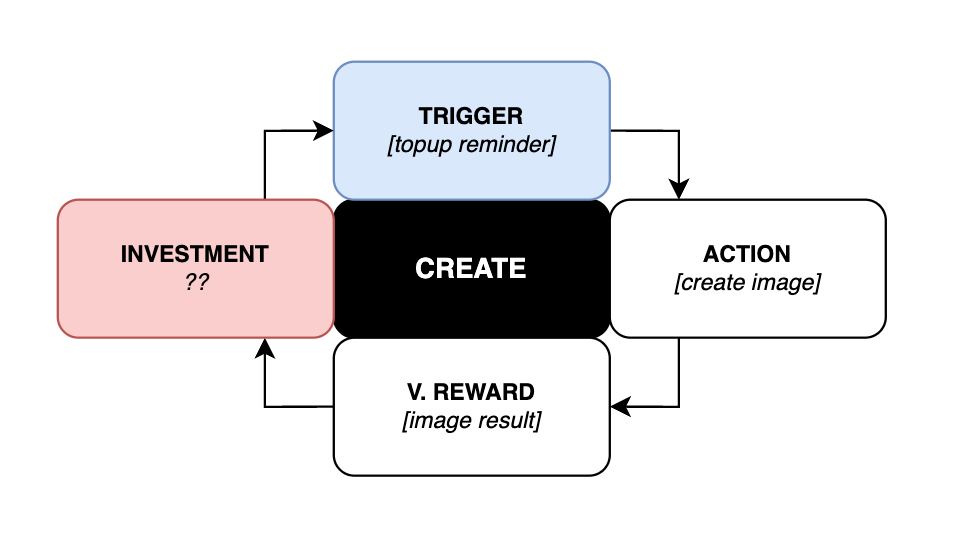
When I joined NightCafe, their core habit loop began with a “daily topup reminder” transactional email (trigger) containing five free credits.
The idea was that after creating with their free credits (action), the novelty of the image produced (variable reward) would then lead them to come back again the next day (investment).
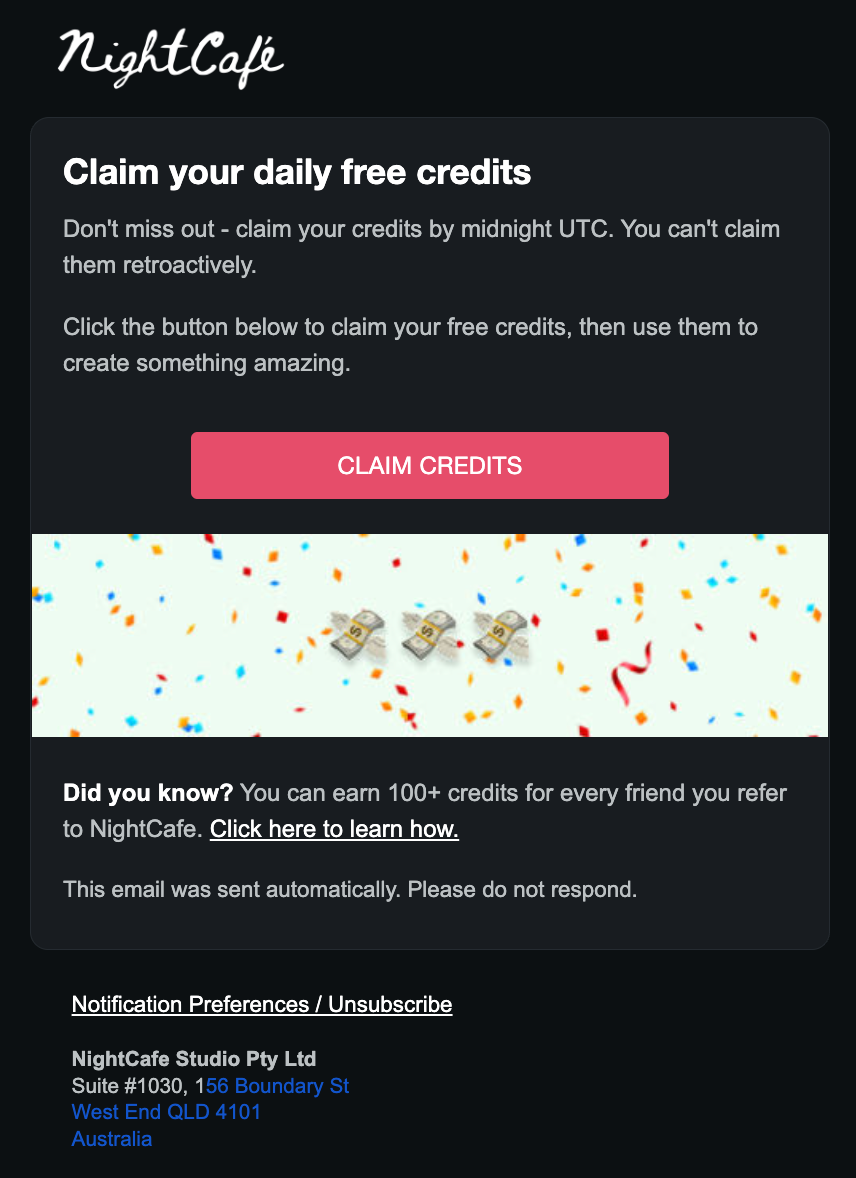
This was a solid design, and the trigger and actions were working well. The biggest problem was the investment stage. The credits were being claimed, but never within the gestalt of either i) having to then go on to actually create an image, or ii) having any actual strong reason to come back after that to create again. Credits were often amassing unused, and a many new users continued to visit once and never return.
Change
We made changes to this loop that had a significant impact on our core user retention:
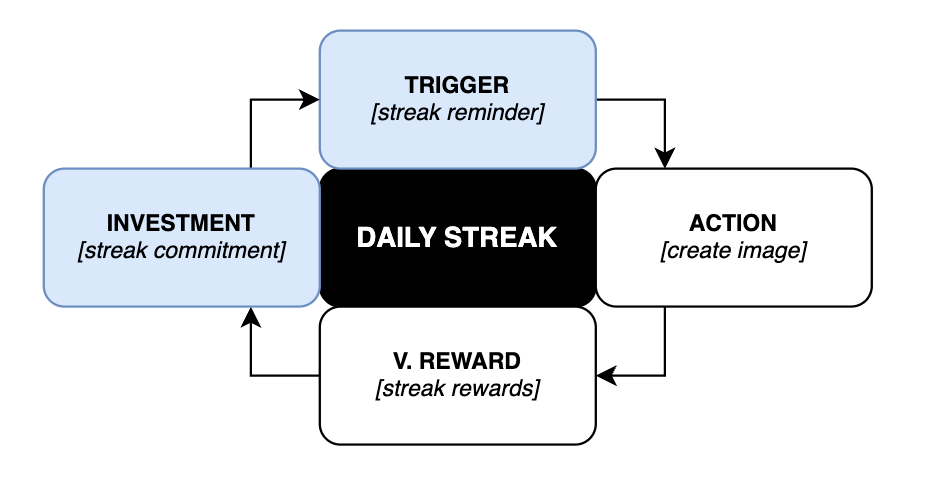
Action: First, we made it so that you couldn't simply claim free credits by visiting the site. You now had to actually create something each day to claim your reward.
This was positioned as a daily free creation that counted towards a daily “streak” count, that would reset if you skipped a day of creating. This creation streak mechanism was actually already running as a separate system on the site, and we had recently surfaced via user interviews that the loss aversion and commitment from this feature was a big reason they were coming back each day to keep creating. They told us they loved the game-like quality of the streak system, being a fun reason to make sure they created every day.
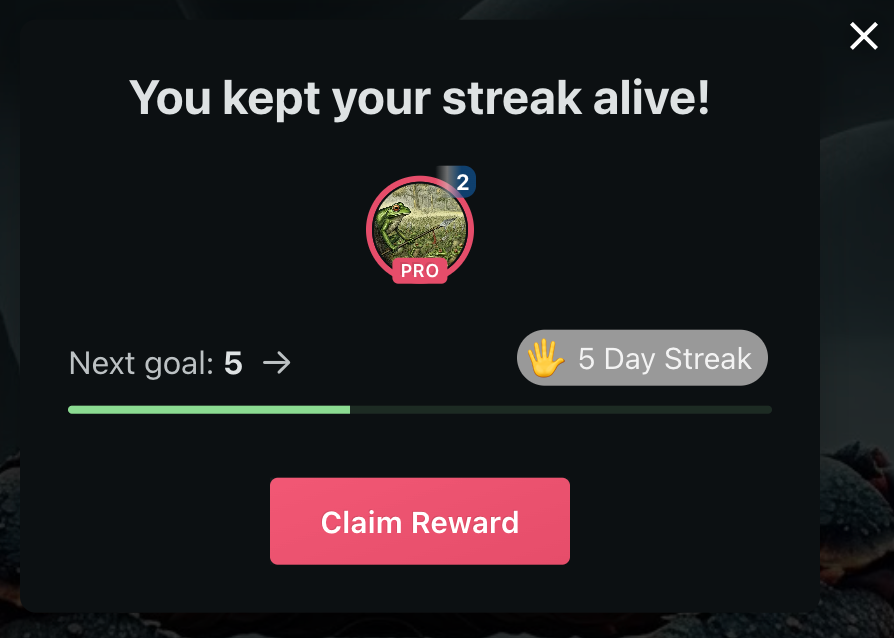
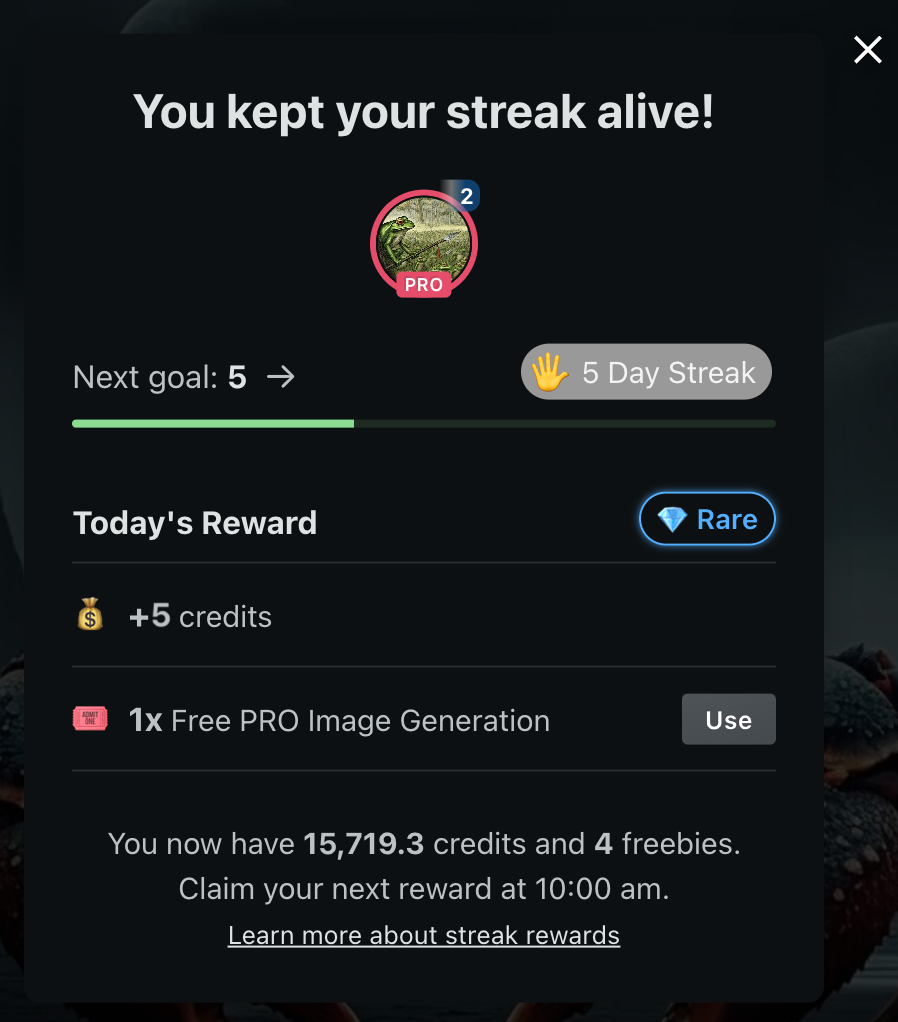
Variable Reward: When a user completed their free daily creation they were now presented with a modal that prompted them to claim their “streak reward”. Instead of just 5 credits each day, this was now based on an actual variable reward schedule that ran anywhere from 5 to 50 credits (plus other non-credit bonuses such as “freebies” for trialling new models to encourage deeper feature exploration).
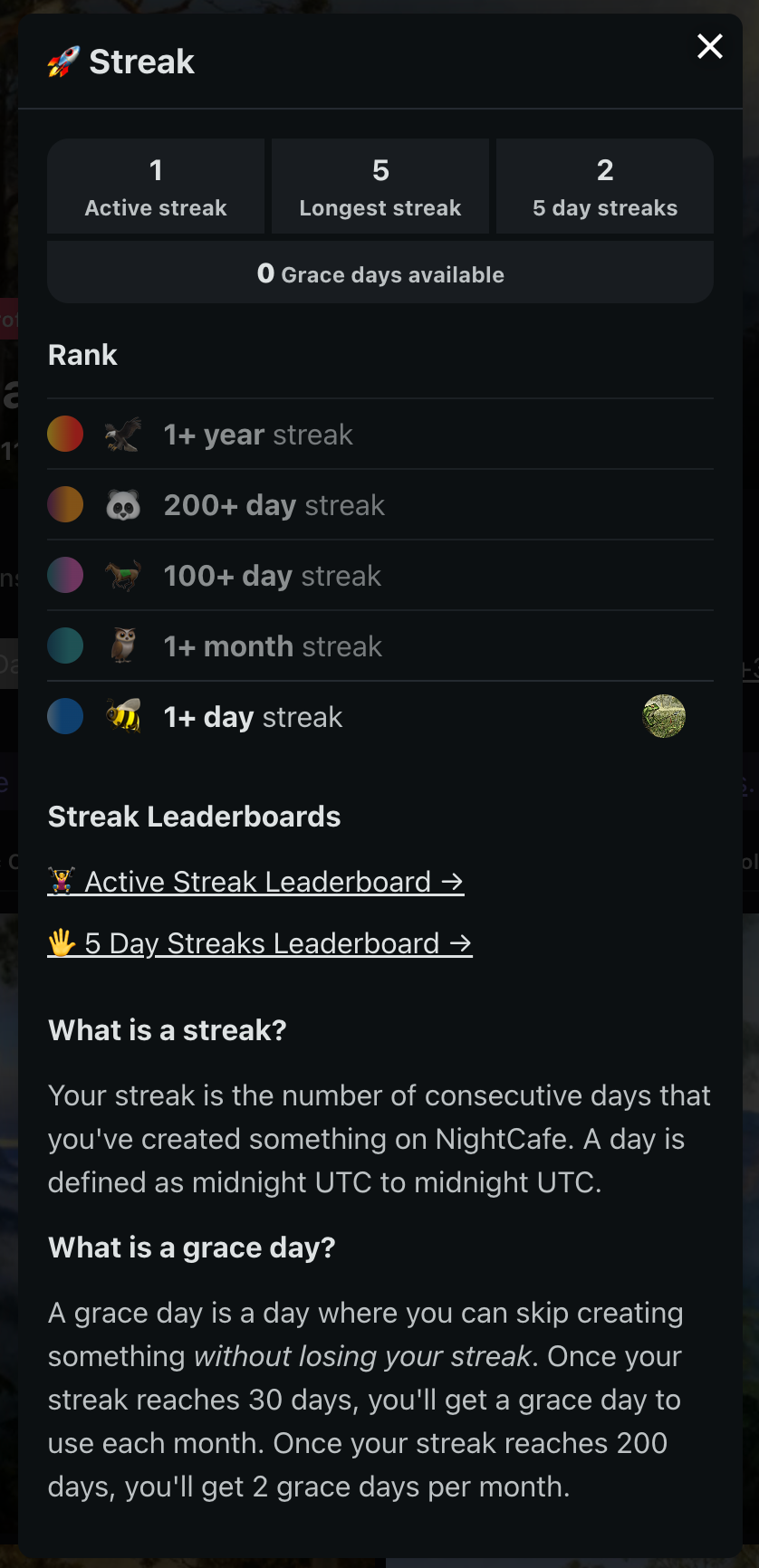
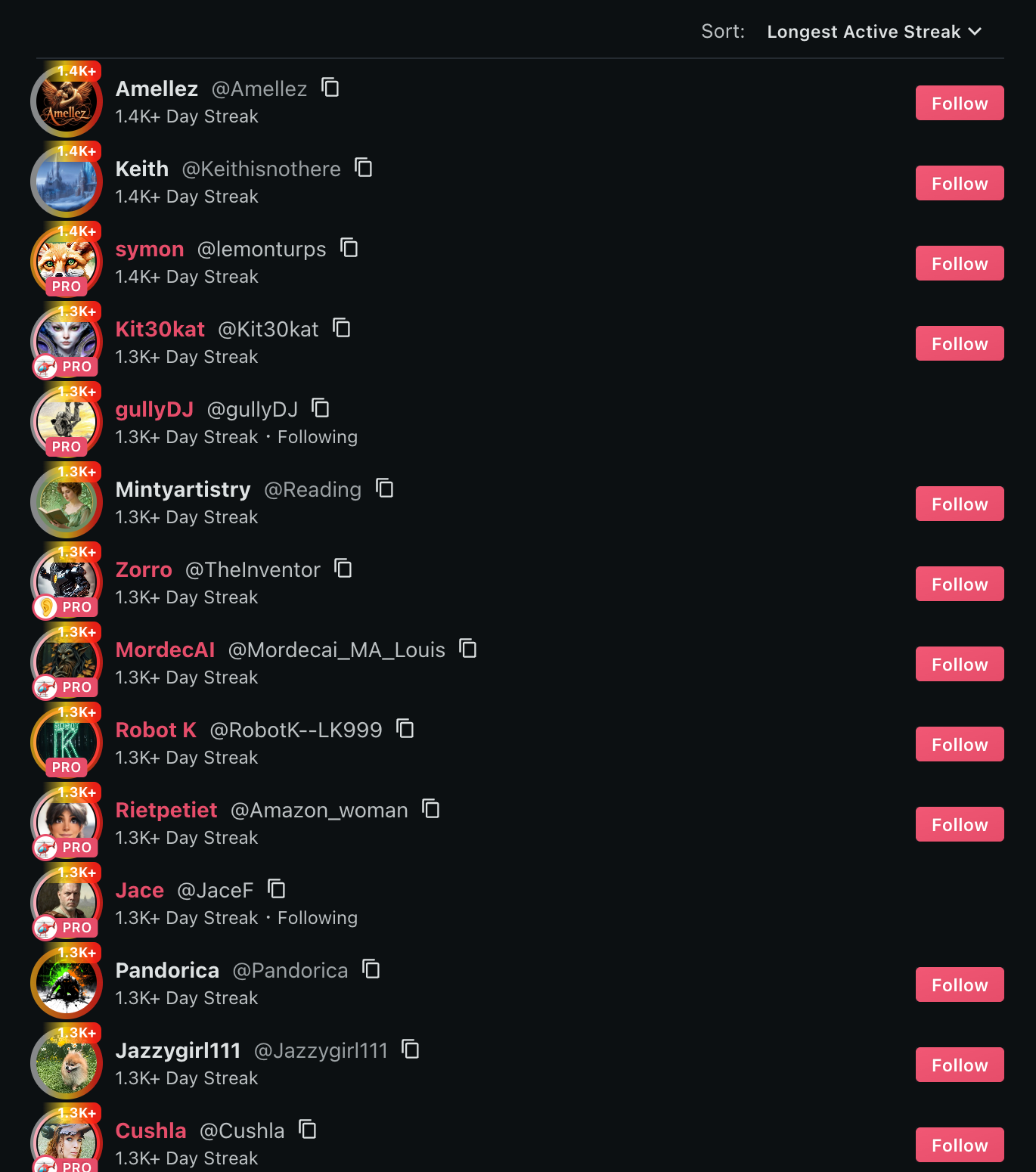
Investment: every time a user created for a consecutive day, they built up their daily streak count. This brought our popular streak mechanism front-and-center for all users. We created a leaderboard and displayed a user’s streak number above their profile card, for competition and status signalling within the community. Losing a streak meant starting again, with a loss of social currency that was painful enough that we had to introduce a “grace days” system to assuage those who weren’t able to keep up their streak due to normal life circumstances.
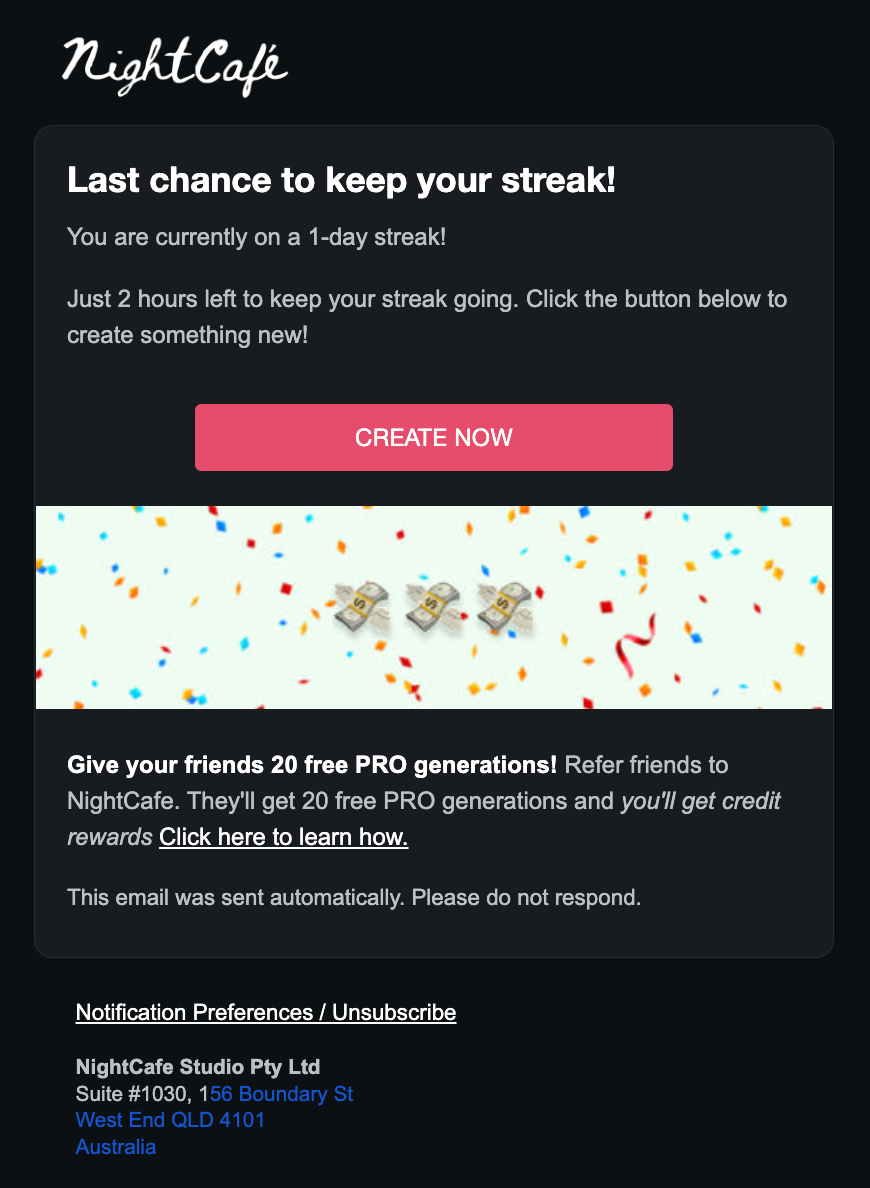
Trigger: Finally, the “daily topup reminder” email was now changed to a “streak reminder”, linking the streak reward back to the trigger action, and solidifying a closed loop between trigger, action, variable reward and investment.
Outcome
This was rolled out to 50% of eligible users in June 2025, followed by 100% in July 2025. Daily Unique Active Creators (DUAC) saw roughly a combined ~30% lift. The step change is clearly visible at both rollout dates, and the new level has held for approximately eleven months, to the time of writing.
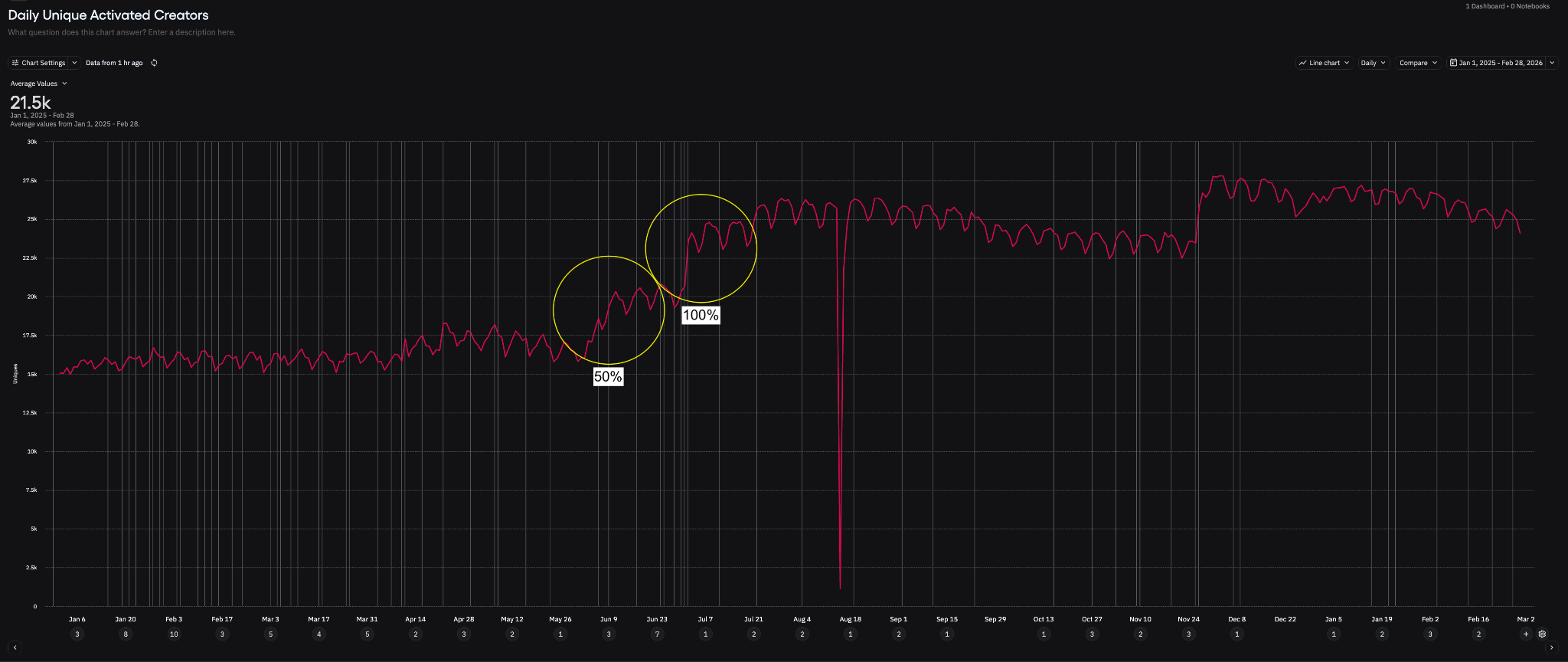
[Chart: Daily Unique Activated Creators — clear inflections at July '25 and Dec '25]
A note on causation: NightCafe runs many growth initiatives in parallel, and the platform has continued to grow over this period. Some of the post-launch level reflects general growth. The two inflection points themselves, however, line up cleanly with the 50% and 100% rollout windows rather than with any broader trend.
Stage Two: Deepening Investment for Paid Users (December 2025)
Before
When I joined NightCafe, we had a lot of effective churn interventions, but weren’t doing much to reward our paid users for long subscription tenure. Their only signifier was a “PRO” badge next to their user card, with nothing that distinguished a two-year die-hard from someone in their first month.
I had been considering some kind of “loyalty program” for a while, and after finding success with redesigning our core habit loop, I wanted to see if we could use this to help reduce churn. After all, an invested habitual user is more likely to convert and become a paid user, and one of our top churn reasons was “not using (NightCafe) enough”. So I assumed that this could be a strong lever.
After free user retention, paid user churn was our biggest concern at NightCafe. While retention is important, keeping churn under control is existential, because no revenue, no bueno. As Jason Cohen from the blog asmartbear writes, “...(it is extremely difficult to) grow your way out of churn… To grow 100% annually with 5% monthly churn, you need to acquire 156% of your current size annually”.
Change
So, we deepened the streak concept further for paid users by introducing a tiered loyalty rewards system. Now the longer you were a paid user, the better your reward each day.
Investment was deepened because losing a daily streak still meant starting again, but they were now paying, and the rewards improved the longer they kept doing so. The status element was also enhanced, as the new loyalty tiers were publicly visible on the user’s profile, with four seniority ranks based on length of paid tenure.
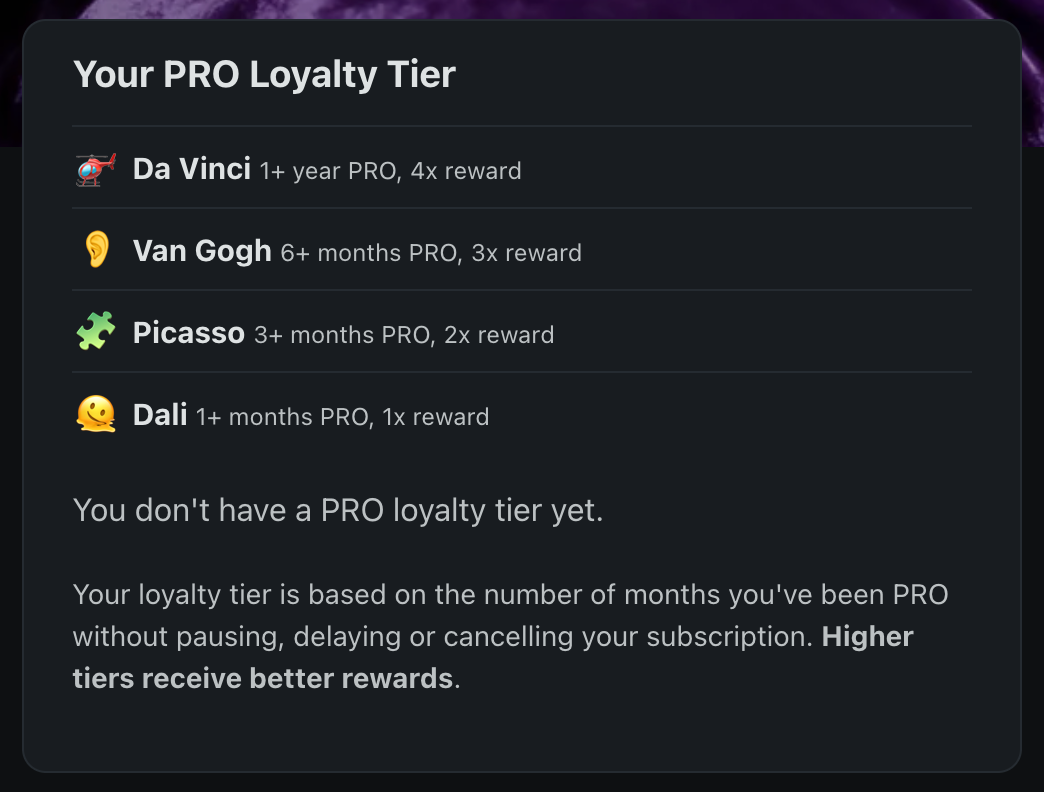
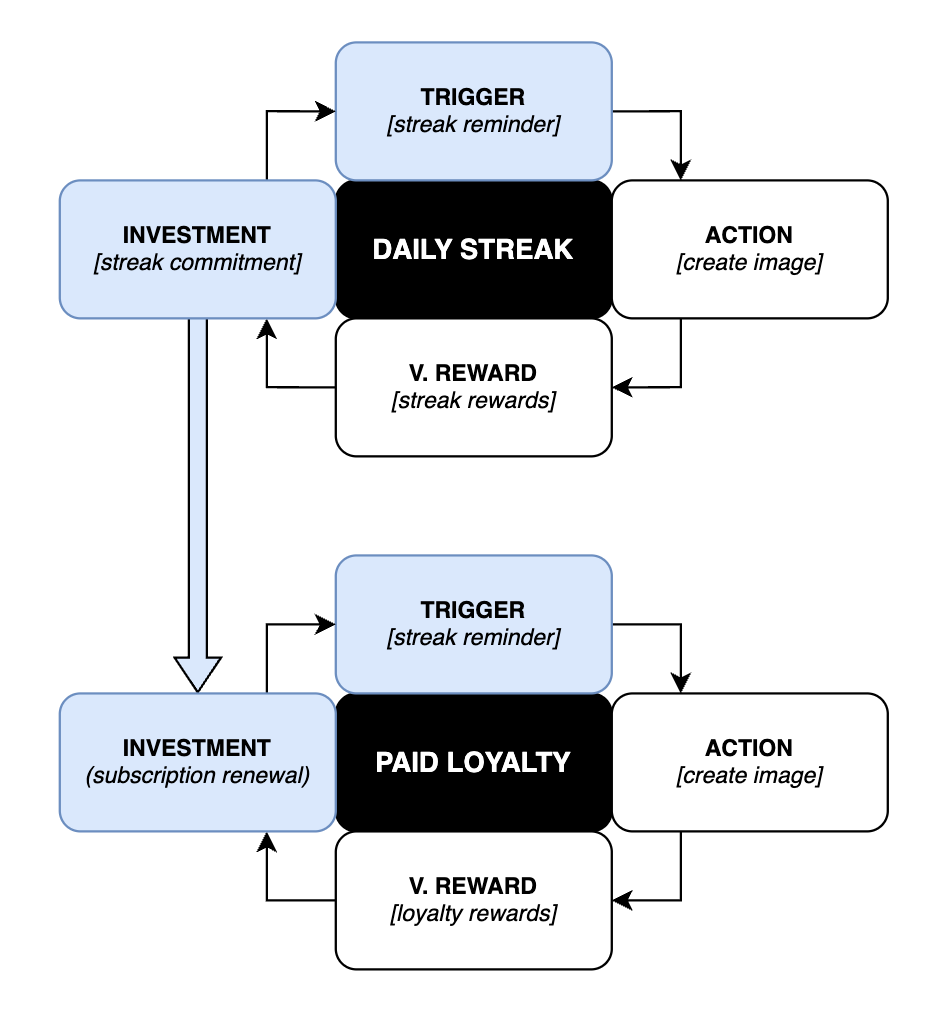
Mapped to the Hooked model, the PRO user still received a streak reminder email as usual (trigger), and created an image to receive their streak reward as usual (action). But the variable reward was now amplified, depending on how long they’d been a paying user. This led to a deeper investment in the daily streak process, therefore reducing the likelihood they would churn from under-use, our biggest churn reason.
It wasn’t a new habit loop, it just deepened the investment stage of the existing one. The only thing new was that two variables now amplified the reward distribution rather than one: the current creation streak and how many months they were a paid user.
Outcome
- Monthly churn rate fell from approximately 8.5% in November 2025 to a projected 6.3% in May 2026.
- The trend has held for five consecutive months, to the date of writing.
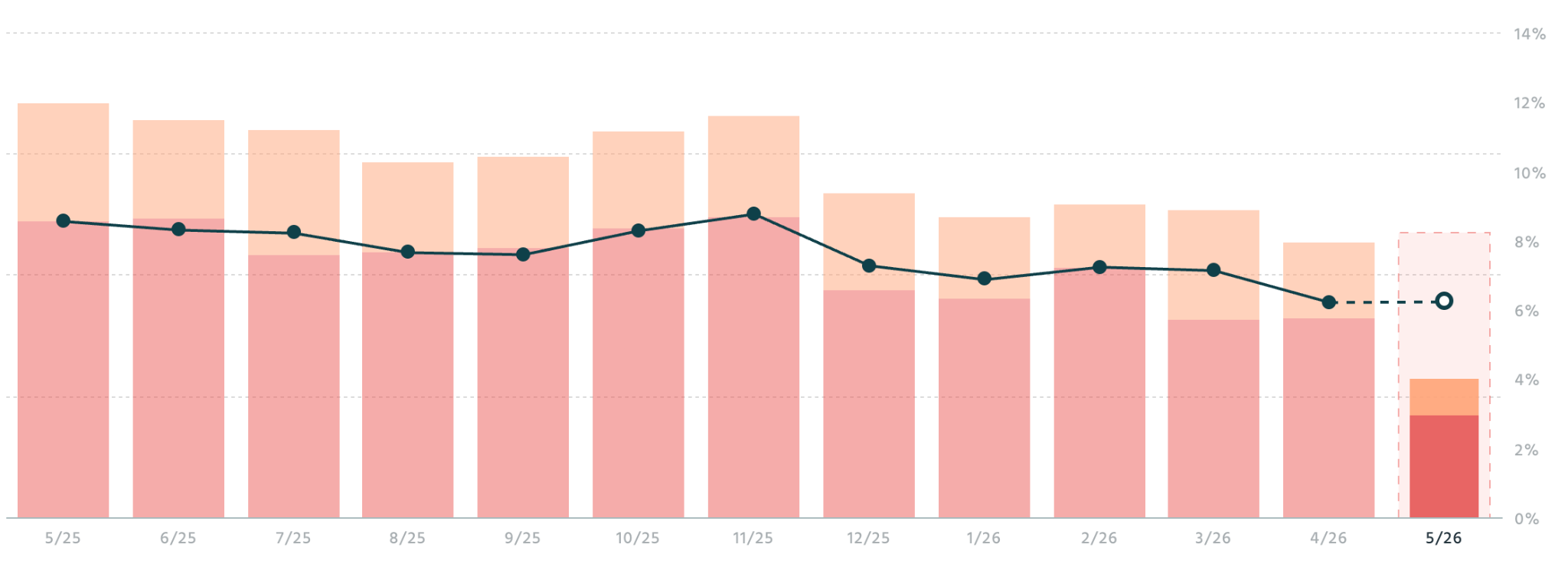
[Chart: Profitwell churn overview — inflection at Dec '25, sustained lower band since].
Again on causation: we did even more for churn over this period, so it was certainly not a neat 1:1 lift. Churn is particularly overdetermined with other experiments likely also contributing here.
Thoughts on Deepening Investment
If you're running a SaaS with any daily- or weekly-use mechanic, here's the diagnostic I'd run on your product:
- List your existing habit mechanics: Emails, notifications, streaks, badges, credit grants, status systems, daily summaries, anything that could plausibly be a Trigger, Action, Reward, or Investment.
- Identify your strongest existing loop. How do you define an activated user? What does the daily cohort of these users look like? The triggers and actions leading to this event may help you find ways to strengthen and incentivise this path.
- Find the underweight stage. It’s usually either going to be a weak variable reward, or poor investment: the trigger fires, the action happens, the reward lands, but the user is building nothing that makes the next pass through the loop more valuable.
- Remember that investment must improve the experience. "Investments increase the likelihood of users returning by improving the service the more it is used" — Nir. How can you increase value for the next iteration? How can you lean into commitment and loss aversion so that stopping usage is costly?
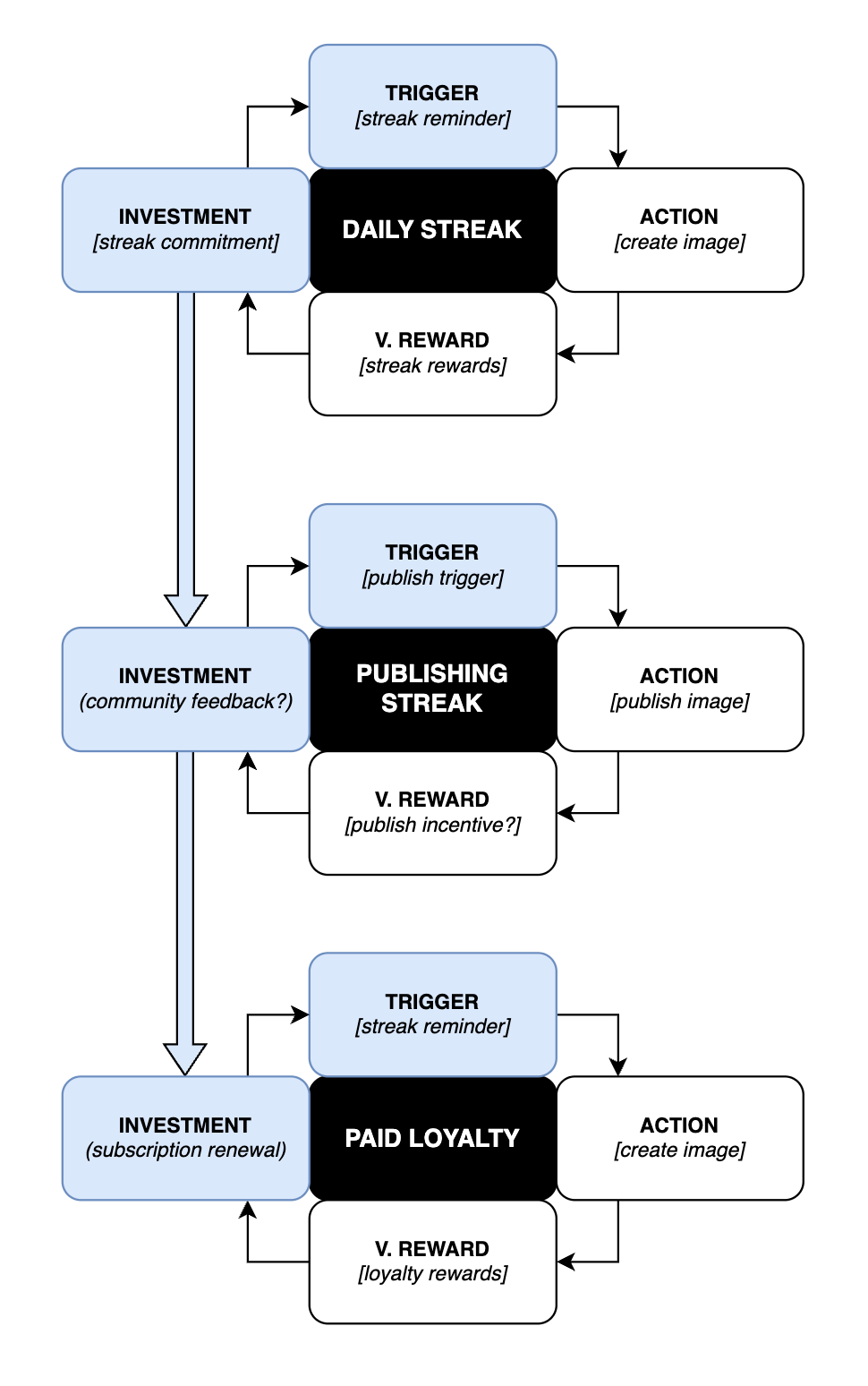
- Stack your loops. Another idea we had but didn’t end up implementing was incentivising users to “publish” their image creations (ie, sharing their image with the platform’s community) by again deepening this same mechanism. So, Create > streak reward > publish reward > pro loyalty rewards. Think about how this might look for your product: what are the actions that create the most value for other users? What are the network effects that make the platform better? How can you incentivise these behaviors?
Summary
Two interventions, both further deepening the investment phase of a thoughtfully designed daily habit loop. Together they lifted Daily Unique Active Creators (DUAC) by approximately 30% (sustained eleven months to date) and monthly churn rate dropped from ~8.5% to a projected 6.3%, roughly a 30% reduction (sustained five months to date, with a meaningful five-figure annual reduction in churn revenue).
The best thing about this is its durability. Many things you try in SaaS sometimes work well for a while, then fall maddeningly back to a tear-soaked baseline. Behavioral-level interventions like these are so powerful precisely because they have so much staying power. They can seem hard to justify at first, because they aren’t quite as legible as shipping a new feature. But the difficult and often messy creative and analytical work required to get them up and running is worth it in the long run as they tend to compound better. And along with using power laws to find leverage points, this kind of compounding is 80% of the game in SaaS.
Are you looking to improve retention and lifecycle economics in your SaaS?
Natural Orders is my consulting practice, specialising in email, lifecycle and retention for SaaS. Get in touch via naturalorders.com and I'll see how I can help.
Thanks to Angus and the NightCafe team for the opportunity.
buy Natural Orders
buy on amazonbuy PDF version