
Increasing Site Conversion 333% | Nir Eyal Case Study
I've had the opportunity to work with author Nir Eyal (Hooked, Indistractable, Beyond Belief), helping manage and grow his email list of product and behavior designers.
This case study walks through how we more than quadrupled the rate at which Nir and Far's visitors converted into subscribers, and what any author or content site can take from the method.
List Building: The Hard Way and the Easy Way
For authors like Nir, their email list is their biggest asset. Book advances and publishing relationships are increasingly based on the size of the platform, of which the list is the most crucial component. It can be pivotal when launching a new book, selling previous titles, and the primary method for nurturing readers for additional products or services.
As I wrote in Natural Orders, there are two ways to double the growth of your email list.
Take a page drawing 10,000 visitors a month that converts 2% of them into subscribers — 200 new subscribers. To double that to 400, you have two options:
- You can double the traffic: slow, expensive, and dependent on search algorithms and platforms you do not control.
- Or, you can double the conversion rate. The longer lever, cheaper, easier, and owned by you.
Nir and Far didn't have a traffic problem. The site drew a large, qualified audience deliberately searching for ideas about habits, focus, and behavior. What it had was a conversion problem: for every 100 visitors, fewer than two joined the email list. The other 98 read an article, bounced, and in most cases never returned.
So in October 2022 we changed the question from "how do we get more visitors" to "how do we keep more of the ones we already have".
Results
Over a 25-month period:
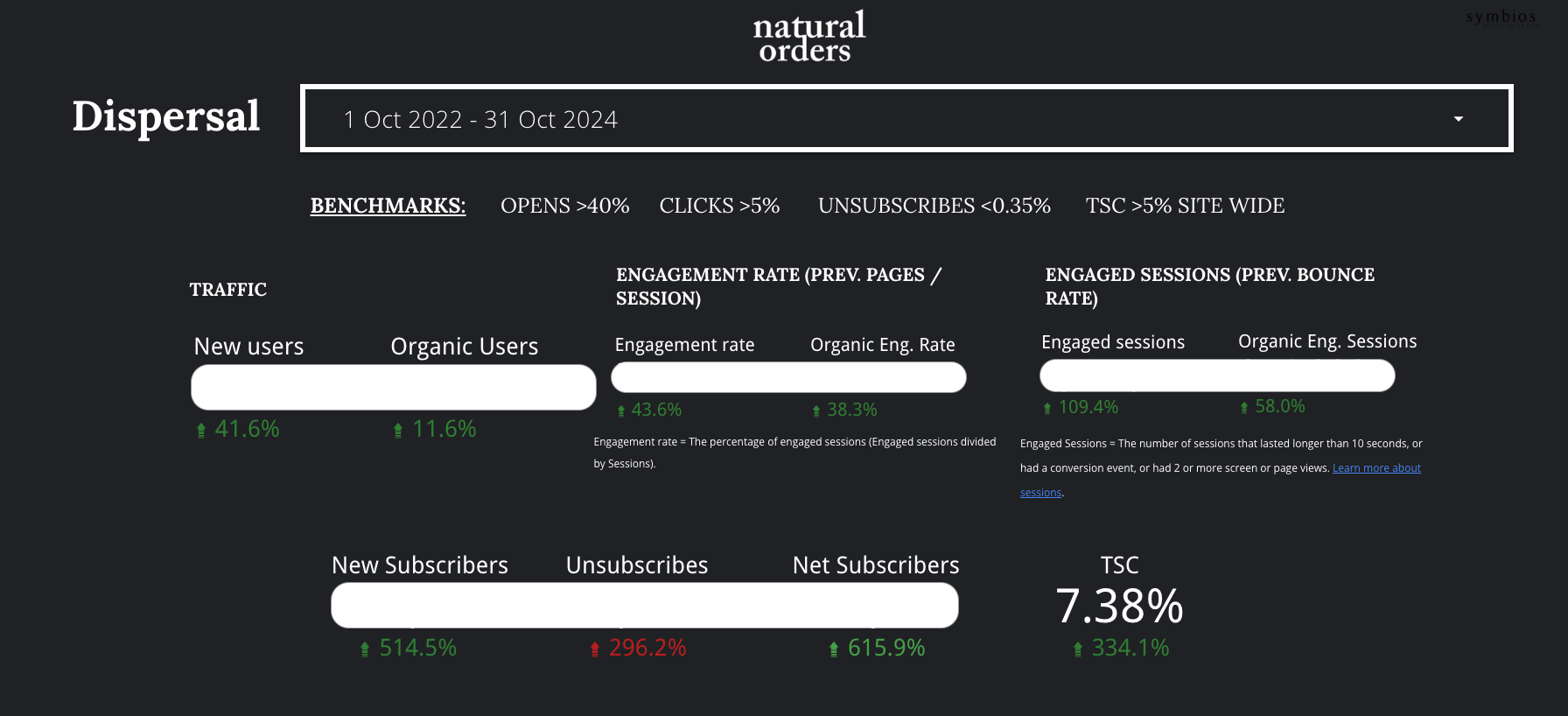
- Traffic / Subscriber Conversion: 7.38% / +334%
- Net new subscribers: 124,713 / +615.9%
Across all industries, the average website converts 1.95% of its visitors into email subscribers. The top 10% of sites reach roughly 4.77%.
Nir and Far began the period at approximately 1.7%, below the average, and ended it at 7.38%, past the top decile. That is a 334% increase in traffic-to-subscriber conversion ("TSC"), achieved with no change to the site's content strategy or publishing schedule, just ongoing, targeted conversion rate optimization.
Finding the Fulcrum
Archimedes said 'Give me a lever long enough and a fulcrum on which to place it, and I shall move the world.' Our long lever is the conversion metric. But where is the fulcrum?
On almost any content site, roughly 20% of pages produce roughly 80% of the traffic. Distributions like this are how attention, links, and most natural systems actually settle. The work is to identify that 20% and concentrate your effort there.
- Sort every page by traffic volume. In google analytics or another analytics tool of your choice. You will likely see the above traffic distribution.
- Work in priority order. A conversion gain on the single highest-traffic page outweighs the same gain on twenty minor pages combined.
- Measure conversion per page, not just sitewide. The sitewide average hides where the gains are. Per-page numbers are your baseline and the only honest way to judge a test later. So export to a spreadsheet and calculate traffic / subscriber conversion per page.
- Experiment with hyper-specific optins for each page. The largest gains came not from generic newsletter boxes but from offers tailored to each individual page. A tool, a worked template, a quiz: something that extends the article instead of interrupting it.
- Keep a changelog. Every change is dated and logged at the page level, with the before-and-after conversion for that page. This is the part most teams skip and the part that compounds. Month six is informed by everything months one through five proved.
- Iterate monthly. Keep wins, revert losses, revisit the top pages. Twenty-five months of this optimization loop is what moved the sitewide average from 1.7% to 7.38%.
Summary
Two ideas explain why this work mattered more than its modest-sounding inputs suggest.
Compounding. Once a page converts at 7.4% instead of 1.7%, every future visitor arrives at the better rate, indefinitely, at no further cost. It also lifts every channel upstream at once. Search, social, and referrals all become more than four times as productive without anyone touching them.
Composition. List composition is downstream of traffic composition. The small set of pages that produces most of a site's traffic also produces most of its subscribers. This means whoever those pages attract is who ends up on the list. If the highest-traffic pages are a poor fit for the brand, aggressive conversion tactics simply manufacture a larger list of people who will not open, click, or stay. Conversion goes up, list health goes down.
The work is finding where small inputs produce large outputs, and then doing that repeatedly. Most of marketing is the search for the right levers, and the fulcrum on which to place them. Adding systematic experimentation and testing in those right places is how you can get large changes over time like this.
---
Natural Orders is an email and lifecycle marketing consultancy working with authors, thought leaders, and software companies. naturalorders.com
buy Natural Orders
buy on amazonbuy PDF version